Advantages of powder metallurgy process:
1. Most refractory metals and their compounds, pseudo alloys, and porous materials can only be manufactured by powder metallurgy.
2. Since the powder metallurgy method can be pressed into the final size of the compact, there is no need or little need for subsequent mechanical processing, so it can greatly save metal and reduce product cost. When the powder metallurgy method is used to manufacture the product, the metal loss is only 1-5%, and when the general melting and casting method is used, the metal loss may reach 80%.
3. Since the powder metallurgy process does not melt the material during the material production process, it is not afraid of mixing impurities brought by the crucible and deoxidizer. The sintering is generally carried out in a vacuum and reducing atmosphere, and it is not afraid of oxidation and will not affect the material. Any pollution, it is possible to produce high-purity materials.
4. The powder metallurgy method can ensure the correctness and uniformity of the material composition ratio.
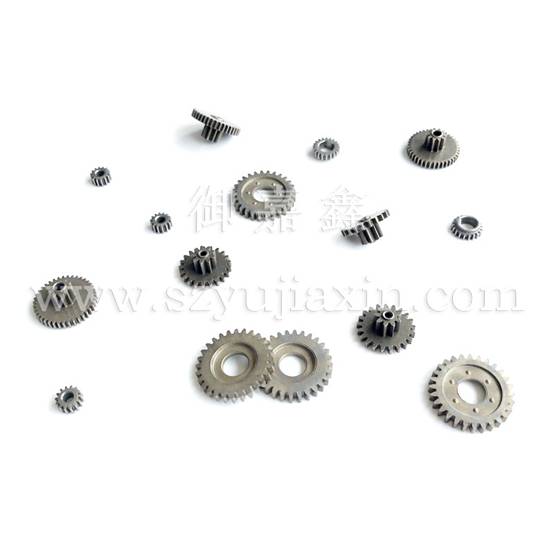
5. Powder metallurgy is suitable for producing products of the same shape and in large quantities, especially gears and other products with high processing costs. The powder metallurgy method can greatly reduce the production cost.
Disadvantages of powder metallurgy process:
1. The mechanical properties of powder metallurgy products (including strength, impact performance, willfulness, etc.) are usually a bit worse than other mechanical processes such as casting and machining;
2. Limited by molds and powder presses, the powder metallurgy process can produce large mechanical products like other mechanical processes. Products with large volume, large area and high quality are usually not difficult to manufacture;
3. Powder metallurgy technology has no advantage in small batch production;
4. Some mechanical products that require high product precision cannot be produced by powder metallurgy technology;
5. The mold cost is relatively higher than the casting mold;
The basic process of powder metallurgy process is:
1. Preparation of raw material powder. The existing milling methods can be roughly divided into two categories: mechanical methods and physical chemical methods. The mechanical method can be divided into: mechanical crushing and atomization method; physical chemical method is further divided into: electrochemical corrosion method, reduction method, chemical method, reduction-chemical method, vapor deposition method, liquid deposition method and electrolysis method. Among them, the most widely used are reduction method, atomization method and electrolysis method.
2. The powder is formed into a compact of the required shape. The purpose of forming is to produce a compact of a certain shape and size, and make it have a certain density and strength. The molding method is basically divided into pressure molding and pressureless molding. Compression molding is most widely used in compression molding.
3. Sintering of the compact. Sintering is a key process in the powder metallurgy process. The formed compact is sintered to obtain the required final physical and mechanical properties. Sintering is divided into unit system sintering and multi-system sintering. For solid-phase sintering of unit and multi-component systems, the sintering temperature is lower than the melting point of the metals and alloys used; for liquid-phase sintering of multi-component systems, the sintering temperature is generally lower than the melting point of the refractory components and higher than that of the fusible components. Melting point. In addition to ordinary sintering, there are also special sintering processes such as loose sintering, immersion method, and hot pressing method.
4. The subsequent processing of the product. The treatment after sintering can adopt various methods according to different product requirements. Such as finishing, oil immersion, machining, heat treatment and electroplating. In addition, in recent years, some new processes such as rolling and forging have also been applied to the processing of powder metallurgy materials after sintering, and have achieved ideal results.
The future development direction of powder metallurgy materials and products:
1. Representative iron-based alloys will develop into large-volume precision products and high-quality structural parts.
2. Manufacture a high-performance alloy with uniform microstructure, difficult to process and completely dense.
3. Use the enhanced densification process to produce special alloys that generally contain mixed phases.
4. Manufacture of non-uniform materials, amorphous, microcrystalline or metastable alloys.
5. Processing unique and non-general composite parts and components.
 info@szyujiaxin.com
  中文
中文 English
 日本語
日本語 Deutsch
 Русский
 SHENZHEN YUJIAXIN TECH CO.,LTD.