In the medicine of the future, tiny robots will navigate independently through tissue and medical instruments will indicate their position inside the body during surgery. Both require doctors to be able to localize and control the devices precisely and in real time.
Until now, there has been no suitable method for this. Scientists from the German Cancer Research Center (DKFZ) have now described a signaling method based on an oscillating magnet that can significantly improve such medical applications.
The study is published in the journal npj Robotics.
What until recently sounded like science fiction is now well advanced in development: Nanorobots that move independently through the body are expected to transport drugs, take measurements in tissue or perform surgical procedures. Magnetically driven nanorobots that navigate through the muscle, through the vitreous body of the eye or through the blood vessel system have already been developed.
However, there is a lack of sophisticated systems to track and control the activities of the robots deep inside the body in real time. Traditional imaging techniques are only suitable to a limited extent. Magnetic resonance imaging (MRI) is limited in temporal resolution, computer tomography (CT) is associated with radiation exposure and the strong scattering of sound waves limits the local resolution of ultrasound.
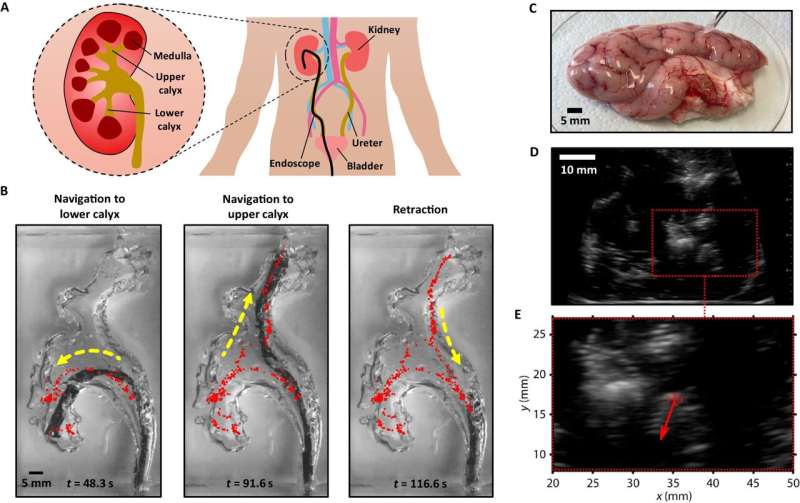
Integration of SMOL for biomedical applications. Credit: npj Robotics (2024). DOI: 10.1038/s44182-024-00008-x
A team led by Tian Qiu from the DKFZ, Dresden site, has now invented a new method to solve this problem. The tiny device they have developed is based on a magnetic oscillator (i.e., a mechanically oscillating magnet located in a millimeter-sized housing). An external magnetic field can excite the magnet to vibrate mechanically.
When the oscillation subsides again, this signal can be recorded with magnetic sensors. The basic principle is comparable to nuclear magnetic resonance in MRI. The researchers refer to the method as "Small-Scale Magneto-Oscillatory Localization" (SMOL).
SMOL allows the position and orientation of the small device to be determined at a great distance (over 10 cm), very precisely (less than 1 mm) and in real time. In contrast to tracking methods based on static magnets, SMOL can detect movements in all six degrees of freedom and with significantly higher signal quality.
As the device is based on weak magnetic fields, it is harmless to the body, wireless and compatible with many conventional devices and imaging techniques.
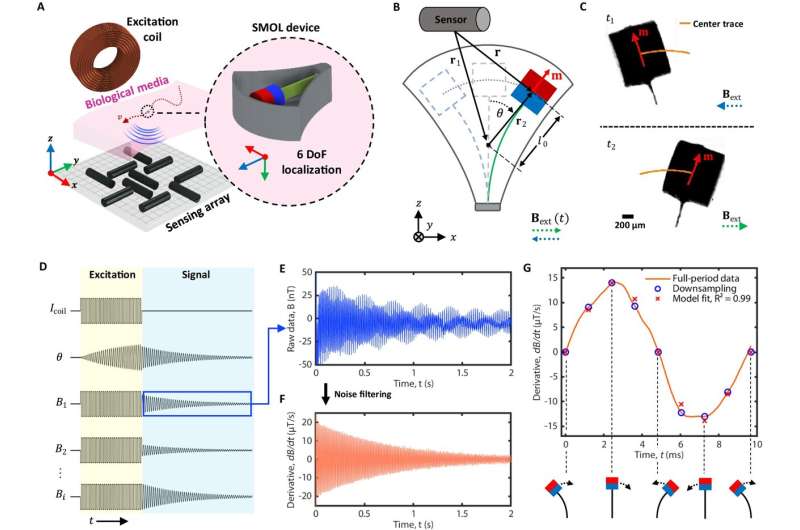
Overview of the SMOL method. Credit: npj Robotics (2024). DOI: 10.1038/s44182-024-00008-x
"There are many possible applications for the SMOL method," says Felix Fischer, first author of the current publication. "We have already integrated the system into miniature robots and instruments for minimally invasive surgery.
"A combination with capsule endoscopes or the marking of tumor tissue for very precise radiotherapy would be conceivable. Our method could also provide a decisive advantage for fully automated surgical robotics or augmented reality applications."
"SMOL only requires comparatively simple technical equipment. Due to its dimensions in the millimeter range, the oscillator can be integrated into many existing instruments, and there is still potential for further miniaturization. Thanks to its precise spatial and temporal resolution, our technique has the potential to significantly advance many medical procedures of the future," comments Qiu, senior author of the current publication.
 info@szyujiaxin.com
  中文
中文 English
 日本語
日本語 Deutsch
 Русский
 SHENZHEN YUJIAXIN TECH CO.,LTD.