In recent years, with the continuous development of manufacturing processes and technologies, people have realized that nitrogen has a huge advantage in stabilizing austenite in steel and can retain the excellent non-magnetic properties of austenite. For stainless steel products, the same applies. Moreover, with the continuous development and application of 3D printing technology, the advantages of
metal injection molding (MIM) high nitrogen stainless steel in the electronic industry are becoming increasingly apparent.
High nitrogen stainless steel was born to replace nickel
Stainless steel is one of the greatest inventions in the history of human material development, and it has now penetrated into every aspect of human production and life. Due to its excellent corrosion resistance, stainless steel is widely used in various harsh industrial environments in the industrial field; In the field of daily life, it is used to make components or final products of various consumer goods (such as tableware), and can maintain a silver metallic luster for a long time, which is loved by consumers.
In the early stages of stainless steel development, research on nitrogen-containing stainless steel did not receive much attention. Firstly, due to production process limitations, it is difficult to add gaseous nitrogen to the molten steel; The second issue was whether nitrogen would cause stainless steel to become brittle, which was controversial at the time. It was not until 1912 that literature first documented the significant impact of nitrogen on the mechanical properties of steel and the stability of austenite. Later, in 1926, another study reported that nitrogen had a similar effect on chromium and iron chromium alloys. Since the 1930s, there have been literature records on the study of adding nitrogen to iron chromium alloys to improve their strength. During World War II, due to the shortage of nickel resources, research on the possibility of nitrogen replacing nickel to stabilize austenite became a hot topic. At that time, in addition to the known influence of nitrogen on the structure and strength of stainless steel, the beneficial effect of nitrogen on the corrosion resistance of stainless steel was also discovered for the first time.
In the development history of high nitrogen steel, two factors have promoted people's thinking about the significance of nitrogen as a stainless steel alloy element: firstly, the supply of nickel, an important alloy element in stainless steel, has gradually decreased; The second is to produce high-strength austenitic stainless steel. When the AOD furnace method (argon oxygen decarburization method) realized the possibility of nitrogen as an alloying element, nitrogen alloying of stainless steel was rapidly promoted. Especially in austenitic stainless steel, by adjusting the nitrogen and manganese content to replace nickel, high-quality and cost-effective high nitrogen stainless steel can be produced, and even the nickel content can be reduced to below 0.1%, thus giving birth to high nitrogen nickel free austenitic stainless steel.
Austenitic stainless steel is one of the most important engineering materials, and due to its strong corrosion resistance, high ductility, and non-magnetism, it has a wide range of industrial applications. Traditional austenitic stainless steel contains a large amount of nickel. Although the presence of nickel stabilizes the austenite structure in steel, there are also some difficult problems to solve. For example, nickel has a higher cost; The presence of substitutional solid solution atoms in austenite cannot effectively improve the strength and hardness of the material; Poor biocompatibility and susceptibility to allergic reactions in the human body limit its application in consumer electronics and biomedical fields.
To address these issues, nitrogen was introduced into austenitic stainless steel to replace nickel, giving rise to high nitrogen stainless steel. Compared with traditional austenitic stainless steel, high nitrogen stainless steel has relative advantages. For example, the stability of nitrogen on austenite is much higher than that of nickel. A small amount of nitrogen can effectively stabilize the austenite structure in stainless steel, reduce the formation of ferrite and martensite in the material during processing, and thus preserve the high corrosion resistance and non-magnetic properties of austenitic stainless steel. Nitrogen, as a interstitial solid solution element, can effectively improve the hardness and strength of austenite while maintaining good ductility of the material. Replacing nickel with nitrogen can reduce the nickel release of materials, improve their biocompatibility, and effectively enhance the resistance of austenitic stainless steel to pitting and crack corrosion.
Therefore, high nitrogen austenitic stainless steel has become a research hotspot in recent years, and its application in industry is also increasing.
Manufacturing High Nitrogen Stainless Steel with MIM Technology
Early development of high nitrogen austenitic stainless steel was mostly based on casting technology, which added nitrogen elements in the molten state of the metal. Due to the low solubility of nitrogen in liquid iron, a higher nitrogen partial pressure is required to dissolve enough nitrogen in the steel liquid. However, this method requires the use of expensive high-temperature and high-pressure equipment, and has certain risks, which hinders its industrial promotion.
Compared to this, the solid solubility of nitrogen in austenite is much higher than that in liquid iron, so stainless steel powder can infiltrate more nitrogen under low pressure when in solid state. This makes powder metallurgy a more economical and effective method for manufacturing high nitrogen austenitic stainless steel. In addition, the use of powder metallurgy technology can also achieve near net forming of products, reduce subsequent processing, and obtain a more uniform structure and properties than casting.
MIM technology is a new near net forming technology introduced by injection molding technology in the field of powder metallurgy. In the process of metal injection molding, first, select the metal powder and polymer binder that meet the requirements, and then mix and extrude them under appropriate process conditions to produce a uniform granular feed. Secondly, through injection molding, the feed is injected into the mold cavity in a molten state to form a green billet. Finally, the binder in the green body is removed through the degreasing process, and then densified metal products are obtained through sintering. The density of the sintered finished product can reach 96% to 98% of the theoretical density, and its mechanical properties are close to those of forged materials.
The advantage of MIM technology lies in its ability to produce complex shaped precision metal parts in large quantities at extremely low cost. Nowadays, MIM technology can be used to manufacture high nitrogen nickel free stainless steel products. At present, the most commonly used high nitrogen nickel free stainless steel grade manufactured using MIM technology in industry is PANACEA. Its chemical composition (mass fraction) is: carbon ≤ 0.2%, nitrogen ≥ 0.65%, chromium 16.5%~17.5%, nickel ≤ 0.1%, molybdenum 3.0%~3.5%, manganese 10%~12%, silicon ≤ 0.1%, and the remaining amount is iron. The nitrogen content of the original powder of this product does not exceed 0.3%. By relying on sintering technology, the nitrogen content can be increased to above 0.65%, ultimately obtaining high-performance high nitrogen nickel free austenitic stainless steel. Although this stainless steel has excellent performance, there are still technical barriers to achieving mass production. For example, nitrogen in this material infiltrates during sintering, and controlling its nitrogen content involves understanding the thermodynamics and kinetics of the nitriding process; The existence state of nitrogen in stainless steel is related to the material heat treatment process; Due to the different sintering furnaces used by different manufacturers, the optimal sintering conditions need to be fully validated in the early stages of production. These factors all increase the difficulty of stable production of this material.
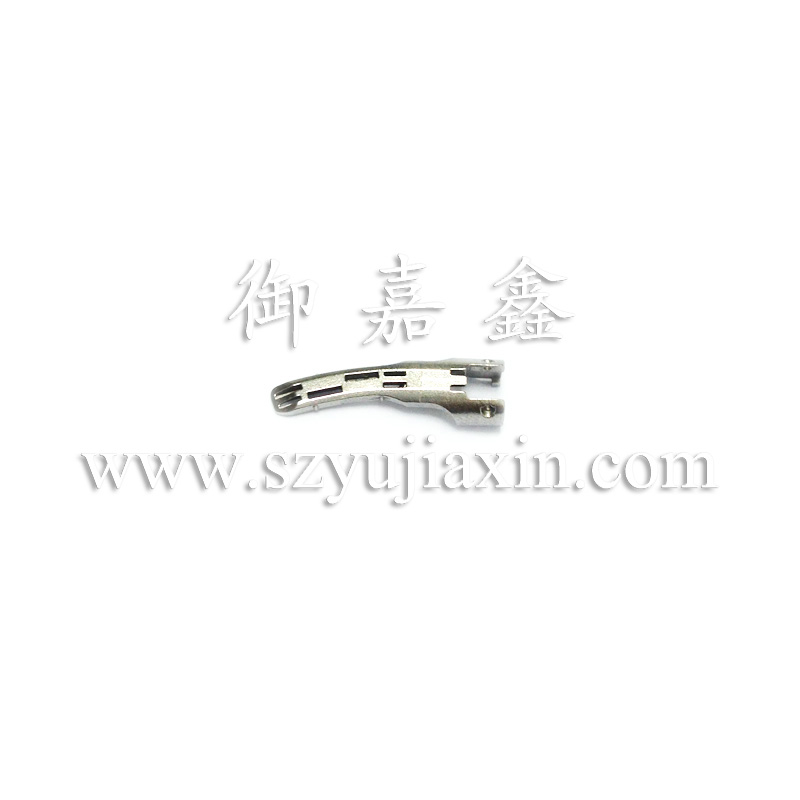
High nitrogen nickel free stainless steel manufactured using
MIM technology has higher strength and hardness than traditional austenitic stainless steel, excellent corrosion resistance, and no magnetism, making it an excellent material for manufacturing electronic product structural components.
Shenzhen Yujiaxin Technology Co., Ltd. adopts metal powder injection molding technology to manufacture various high-precision and complex structural metal components. It has rich experience in the field of high nitrogen and nickel free stainless steel manufacturing and is committed to breaking through industry technical barriers in high-end product components such as medical, industrial, military, and consumer electronics. Huawei has been using this material to manufacture the camera bracket for its flagship mobile phone since the end of 2017, and has since gone through two generations of mobile phone products. At present, four camera brackets have been mass-produced, each with a shipment volume of several million pieces, making them a classic application case of injection molded high nitrogen nickel free stainless steel. With the promotion of Huawei, more and more mobile phone structural components will choose this high nitrogen nickel free austenitic stainless steel material. I believe that in the near future, high nitrogen nickel free stainless steel manufactured using MIM technology will usher in more development opportunities.
 info@szyujiaxin.com
  中文
中文 English
 日本語
日本語 Deutsch
 Русский
 SHENZHEN YUJIAXIN TECH CO.,LTD.