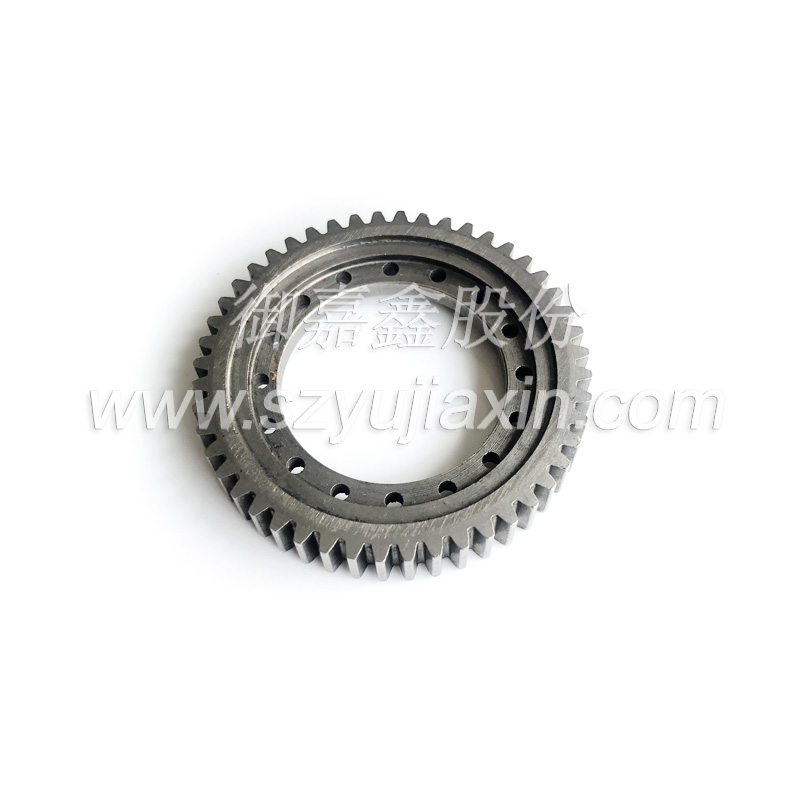
For powder metallurgy, it can bear torque up to 14NM, and the torque for warm-pressing parts can reach 20NM. If the warm-pressing FD0405 is used, the torque can reach around 25NM. Therefore, under the condition of professional powder metallurgy design and allowable improvement, the lightweight can be increased by 30-40%. Adding 2-3% of Ni and 2% of Cu to the material and sintering it can significantly improve the material's flexibility and impact strength.
The precision of
powder metallurgy depends on the coefficient of expansion of the material and the precision of the mold. For domestic molds with a diameter of 50mm or less, the precision is generally around 8-9 grades, while for imported molds, it is around 7-8 grades, and for helical gears, it is one grade higher. The advantage of powder metallurgy gears lies in the ability to produce them in bulk and with excellent consistency.
The main reasons for poor strength after powder pressing include the following:
Particle size and shape: The size and shape of the particles have a significant impact on the strength of the powder. Particles that are too large or too small can lead to a decrease in powder strength. Particles with a regular shape, such as spherical particles, typically have higher strength. For example, the packing density of spherical particles is larger, and the voids formed are smaller, resulting in stronger adhesion.
Particle density and structure: The density and internal microstructure of the powder also affect its strength. The higher the density, the higher the powder strength. Loose parts in the microstructure will affect the overall strength of the powder.
Surface properties: The surface properties of the powder, such as roughness and hygroscopicity, have a significant impact on adhesion and friction. Powders with rough surfaces or high hygroscopicity are more likely to reduce strength.
Pressure and die: Insufficient pressing pressure can result in poor bonding between powder particles, thereby reducing strength. The smoothness of the die also affects friction, which in turn affects the density distribution of the compact.
The use of lubricants: The use of lubricants can reduce the friction between the powder and the mold wall, but if lubricants are used improperly or in excess, it can cause uneven distribution of compact density, thus affecting strength.
Raw material quality: The selection and handling of raw materials have a direct impact on the powder strength. For example, using the wrong materials or improper storage that leads to oxidation, moisture absorption, etc. can all reduce the powder strength.
Pressing method: Improper pressing method can also lead to a decrease in powder strength. For example, uneven compression ratio in different parts of the pressing process, incorrect pressing method, etc. will affect the final product's density and strength.
Measures to increase the strength of the powder after compression include:
Choose the appropriate particle size and shape: Using medium-sized particles and powder with regular shapes can significantly improve strength.
Controlling the pressure during compaction: Increasing the pressure during compaction can enhance the bond strength between powder particles, thereby increasing the strength of the compacted material.
Optimizing mold design: Using high-hardness molds and maintaining the smoothness of the mold can reduce friction and ensure a uniform distribution of density in the pressed mass.
Use lubricants appropriately: Choose the right lubricant and control its use to reduce friction and ensure a uniform density of the compact.
Control the Quality of Raw Materials: Ensure the quality of raw materials to avoid issues such as oxidation and water absorption.
Improving compression method: Optimizing various aspects of the compression process to ensure consistent compression ratios throughout the material and avoid uneven density caused by improper compression methods.
 info@szyujiaxin.com
  中文
中文 English
 日本語
日本語 Deutsch
 Русский
 SHENZHEN YUJIAXIN TECH CO.,LTD.